Wednesday, October 12, 2016

Upton Remodel Photos: October 2016


It's a mad dash before winter sets in!

The old "deck" was very rickety, and over the last few months, a couple of the stairs actually broke through, to the point we were only walking on the stair supports. Now, though it isn't quite done, we actually have a large deck, which is very useful as a workspace if nothing else!

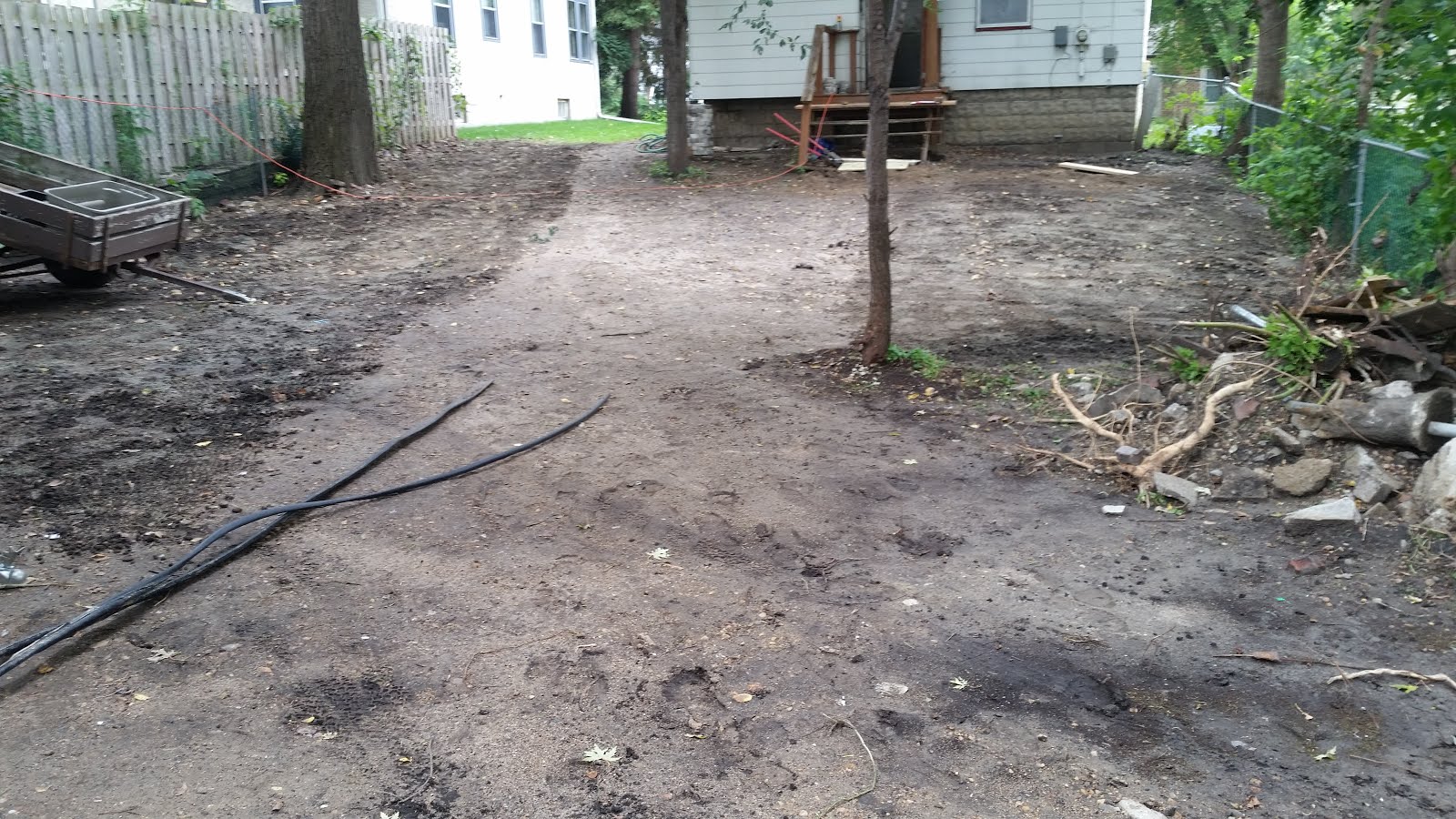
The backyard was full of stumps, fence posts, bumps, holes, litter...it needed major work. So we finally called in a Bobcat, who leveled the whole thing and took out many of the fenceposts and stumps. We don't really have much grass yet; we'll need to lay sod come spring, but it looks SO much better!

The dining room ceiling was caving in, so we jacked it up, and installed extra support beams in the attic, so now there is only a small sag, which won't be noticeable once we get the drywall up!


The basement had serious moisture issues. There was mold on the walls, and the concrete floor was actually completely buckled - no huge shock, seeing as it was only 1/2" thick! We tore out all the concrete, installed drain tile (which is already functioning well!), and poured new concrete. It's a whole new basement!


We tore out the chimney, so created a hole in the roof. There were also many roof boards that needed to be replaced, so we fixed that all up before we put new shingles on.

Monday, September 19, 2016

Upton Remodel Photos: September 2016

Before:
Gross bathroom, and plumbing below the bathroom
See that chimney? It's gone now!

NOW!
Straightened the garage, and installed a new door
Bricks from the chimney! Easily dismantled by hand.
New plumbing in basement
Bathroom in progress
New front steps
Drain tile in basement for moisture issues.
Egress Window
We tore down a wall, so you can see all the way from the kitchen through to the living room!

Monday, September 9, 2013

Working at Valleyfair

I've always wondered what it would be like to work at a roller coaster park. I've loved coasters my whole life, and in the back of my mind, it was always something I wanted to do. Finding myself unemployed during the summer, ​I saw that the local park was hiring for the end bit of the season, to replace all the college kids who were heading back off to school before the park closed. I knew I would be older than most of the employees, but especially at first, being 24 made me feel super old when almost everyone else there is between 16 and 22.

Oncoming riders! Welcome to Xtreme Swing! You may now enter by pushing on the gates in front of you. Loose articles such as hats, bags, glasses and flip-flops are not permitted on the ride and must be left with a non-rider or placed in the storage bins. Valleyfair is not responsible for items lost or damaged during the ride and you accept all responsibility for items left in the bin. Once seated, pull down the lap bar and fasten the belt. If you need assistance, please notify a loader to help you.

While I have been trained on more rides than Xtreme Swing (Minnesota River Valley Railroad, Monster (Octopus), Corkscrew (roller coaster)), it's the one where I spent most of my time. I literally dreamed about running the ride, over, and over, and over again, for many nights after getting off work.

Some things about working there were awesome!
  • I got to test-ride each of the rides I worked on, including once while wearing kegel balls. I was paid to ride a ride while wearing kegel balls. Take that, bucket list!
  • Kids between 48 and 52 inches tall are adorable
  • People always ask me if Xtreme Swing is scary - I don't think so. Heck, my dad said it almost put him to sleep when he rode it! But I generally tell them that it depends on your perspective.
Working there, especially at first, was very hard, as I knew it would be. I was working over 50-hours some weeks, in the heat, constantly on my feet, walking as many as about 20 miles (rough estimate) back and forth around the platform all day. However, I got some *skills* I didn't quite expect
  • By the end of the 3 weeks of full time work, I wasn't completely exhausted after a 13-hour shift on my feet in the sun
  • I learned to shout over constantly loud noises (rides, music, people...)
  • I developed the ability to recite scripts very very fast
  • I can easily spot people wearing glasses, flip-flops or hats
  • I can also easily notice people not wearing short skirts or pants over their swimsuits, as well as guys not wearing shirts (but I didn't need Valleyfair to teach me that)
  • I learned all the highways that go around the southern metro (between traffic and road construction, I took a wide variety of routes)
  • My shins got fairly bruise resistant as I was generally kicked on a daily basis by people who can't hold their feet still when they're hanging free
  • I have gotten more tan than I have ever been before and my arm hair looks white against my skin
And of course, I learned some fun behind-the scenes bits:
  • Redbox is Valleyfair code for "throw up" - try talking to a Valleyfair employee about red boxing
  • The employee café called the Best Day Bistro serves the same food as in the parking except much cheaper
  • Rotating positions is the key to avoiding boredom. Everyone pretty much knows at least 3-4 positions, most people tend to know a dozen or more. You generally rotate every hour or so. Apparently nobody just says the spiel all day like I'd originally thought.
  • Everyone has a very distinct farmers tan with the V-neck from a polo shirt and shorts
  • Apparently lifeguards have the most boring job
  • The control booths are often air-conditioned to be freezing cold
  • There's more to running the ride than pushing the go button, but not very much more
  • Some people look really weird when they're riding rides. Xtreme Swing especially ranges from pure terror to boredom.

For the most part, experienced riders are the most pleasant, because they know what they're doing. However, even expert riders forget things sometimes. Here are some tips for novice riders and coaster junkies to keep in mind to make the days of the ride operators they interact with:
  • If you can't figure out your harness, don't scream about it, or act confused or stupid. Just patiently wait for the ride operator to get to you to buckle it. You are not the only one who couldn't figure it out. Heck, only about 3/4 of people know how the harnesses work, and most of them have probably ridden the ride before.
  • I don't know why anyone would wear their hair down to an amusement park. It's your choice, but it will get in your face and tangled.
  • When you are told to put your hands up so we can check your restraint, don't expect us to think you're witty saying some remark in response. We've heard it all.
  • When there is a grouper telling you where and how to sit, know how many people you are with and/or how and if you want to divide ahead of time, before being asked. It helps us so much you have no idea. Also, if you're riding alone, be alert for the grouper to call for a single rider. You will get on the ride faster, and make the grouper happy.
  • If you're too fat/tall to ride, just realize it when you can't get the restraint to lock. We can't push extra hard to fit you in, so just recognize it and bow out. Nobody wins when we have to tell you you're too fat to ride.
  • If you're too short (or with a kid who is too short), don't protest. Cedar Fair parks and likely other parks let kids get measured with a doctor style measurer. The kids can wear a wristband with their height, so the ride operator doesn't have to stress as much about comparing them to the height of a stick. Please get them measured, and don't have them try to get on rides they aren't tall enough for.
  • Last but not least, LISTEN to the ride operator. While you don't HAVE to take your phone out of your pocket, believe us when we highly encourage you to not leave them in your basketball short pockets. We have seen them fall out. If glasses aren't allowed, either wear a strap or take them off without complaint. I know they won't fall off, but those are the rules, and I could get in trouble if you keep them on.
  • Smile and waive at the ride operators as the train leaves the station, or we exit the platform. Sometimes that's all it takes to make our day.
  • Don't make weird faces, etc. at the control booth while they are giving a spiel. It's probably fine for more experienced operators, but it sometimes doesn't take much for me to get distracted.

Tuesday, November 1, 2011

Pottermore Wand

On Pottermore, I received a Cherry and Phoenix Feather wand, 10" long, and quite bendy.

According to Rowling, the interpretation is:

WOOD: Cherry - This very rare wand wood creates a wand of strange power, most highly prized by the wizarding students of the school of Mahoutokoro in Japan, where those who own cherry wands have special prestige. The Western wand-purchaser should dispel from their minds any notion that the pink blossom of the living tree makes for a frivolous or merely ornamental wand, for cherry wood often makes a wand that possesses truly lethal power, whatever the core, but if teamed with dragon heartstring, the wand ought never to be teamed with a wizard without exceptional self-control and strength of mind.

CORE: Phoenix Feather - This is the rarest core type. Phoenix feathers are capable of the greatest range of magic, though they may take longer than either unicorn or dragon cores to reveal this. They show the most initiative, sometimes acting of their own accord, a quality that many witches and wizards dislike. Phoenix feather wands are always the pickiest when it comes to potential owners, for the creature from which they are taken is one of the most independent and detached in the world. These wands are the hardest to tame and to personalize, and their allegiance is usually hard won.

LENGTH: 10" is within the average range, and length doesn't have significant impact within that range.

FLEXIBILITY: "Quite bendy" represents an adaptability and willingness to change.

But the second time I took the quiz, it gave me:

SYCAMORE WITH UNICORN CORE, TEN AND A QUARTER INCHES, UNBENDING


WOOD: The sycamore makes a questing wand, eager for new experience and losing brilliance if engaged in mundane activities. It is a quirk of these handsome wands that they may combust if allowed to become ‘bored,’ and many witches and wizards, settling down into middle age, are disconcerted to find their trusty wand bursting into flame in their hand as they ask it, one more time, to fetch their slippers. As may be deduced, the sycamore’s ideal owner is curious, vital and adventurous, and when paired with such an owner, it demonstrates a capacity to learn and adapt that earns it a rightful place among the world's most highly-prized wand woods.


CORE: Unicorn hair generally produces the most consistent magic, and is least subject to fluctuations and blockages. Wands with unicorn cores are generally the most difficult to turn to the Dark Arts. They are the most faithful of all wands, and usually remain strongly attached to their first owner, irrespective of whether he or she was an accomplished witch or wizard.
Minor disadvantages of unicorn hair are that they do not make the most powerful wands (although the wand wood may compensate) and that they are prone to melancholy if seriously mishandled, meaning that the hair may 'die' and need replacing.
FLEXIBILITY: "Unbending" represents a refusal to change.

Friday, October 14, 2011

Family Photos Classification

I just have to get this out there: I LOVE classification systems. I’ve always loved organization, and good classification systems are like the epitome of perfected organization.

When posed with the scanning and organization of a large photo collection, I was determined to come up with a numerical classification scheme, somehow based on the family tree. Friends who I told who didn’t have any background in library/information science were totally dumbfounded that I intended to give each photo a unique number that would MAKE SENSE. Friends who were information scientists were also amazed that I would take on such a task, with such high expectations of myself.

It took a couple weeks to develop, but it finally came to me, suddenly.

I figured out how to organize them based on who is in the picture. Since pictures with members of the same nuclear family are most common, I set the nuclear family as the primary arrangement. I created a family tree, and gave each nuclear family a 3-digit number (starting with 001 and increasing semi-arbitrarily). Within each family, I lettered the family members, starting with the father and mother. Thus, every person has a 4-character number. You may realize that as people get married/re-married, etc, they would have more than one individual number. I created the standard that each individual goes by the default of their first (child) number, but the other numbers are indexed, so they can be retrieved according to any of their numbers. That is the numerical scheme for photos of an individual. If there is more than one person from the same nuclear family in the photo, I replaced the letters (a/b/c/d..) with the letters W (parents), X (parents and kids), Y (kids), or Z (parents/kids/grandkids/great grandkids). Thus, each photo is labeled 001d, 060W, etc. Then, once the photos are sorted, I weeded out duplicates, keeping the best copy of each image. Then, as I scanned, I added a 3-digit number to the end, so they each were uniquely matched with their digital counterpart. Final numbers were: 001d_013, 060W_046, etc.

For photos that did not nicely match the nuclear family scheme, I created “families” (999, 998, etc) that described more obscure relationships, or non-family members. All of the photos are scanned as high-resolution TIFFs, with thumbnail JPG versions, and are fully indexed and described in an Excel spreadsheet, so with full text-searching capabilities, everything is retrievable digitally, as well as physically. The photos are saved digitally on my internal hard drive, and backed up on my external hard drive. Once photos are scanned, they are stored in archival storage boxes (naturally in the same order as the numerical scheme). The format (small print/large print/slide/negative) is specified in the description in Picasa so that physical retrievability is possible.

Photo albums were also scanned as a part of the project. I used the basic numerical structure, with an additional field inserted that identified the album. For example, 001e_1950a_p001 would be 001e's first scrapbook from 1950, page 1.

Friday, August 12, 2011

SLIS Assignment

The online environment has been evolving rapidly ever since it came into existence. I was first introduced to Google Calendar in 2007, and was hesitant - I used Yahoo email and a paper calendar, and was content with that. But then I discovered the world of Google collaboration, and the world seemed to open. Google Docs has been an invaluable tool in educational, professional and social collaboration for the past three years of my life. Google Calendar and sharing settings help enable live collaboration. Skype, Elluninate, Wikis, and countless other internet services are amazing tools in collaboration, especially in an online-only environment.


The personal skills needed to succeed as an online student are really quite similar as those needed to succeed as a self-motivated student in a traditional school setting. Since eighth grade, I've done a number of academic independent studies, and found it crucial to set personal deadlines that aligned with the professor's assignment deadlines. If working in a group, deadlines should be clear to all participants for each phase of the project, so everything gets completed on time and nothing is left out.


One of the reasons I was particularly attracted to the idea of an online MLIS is that I am a visual learner. I have often found myself in the position where I was the only one in the class that read the assigned textbook reading, and found the lecture to be a complete regurgitation of the text material. An online program, being primarily textual/visual, is very appealing. I can also hold a job in my area of interest, while doing my coursework after dinner.


I see myself as generally good at time management, organization, self-motivation, working independently, and I love working with technology, and am always up for a challenge. Let the semester begin!

Tuesday, August 9, 2011

RCHS Store

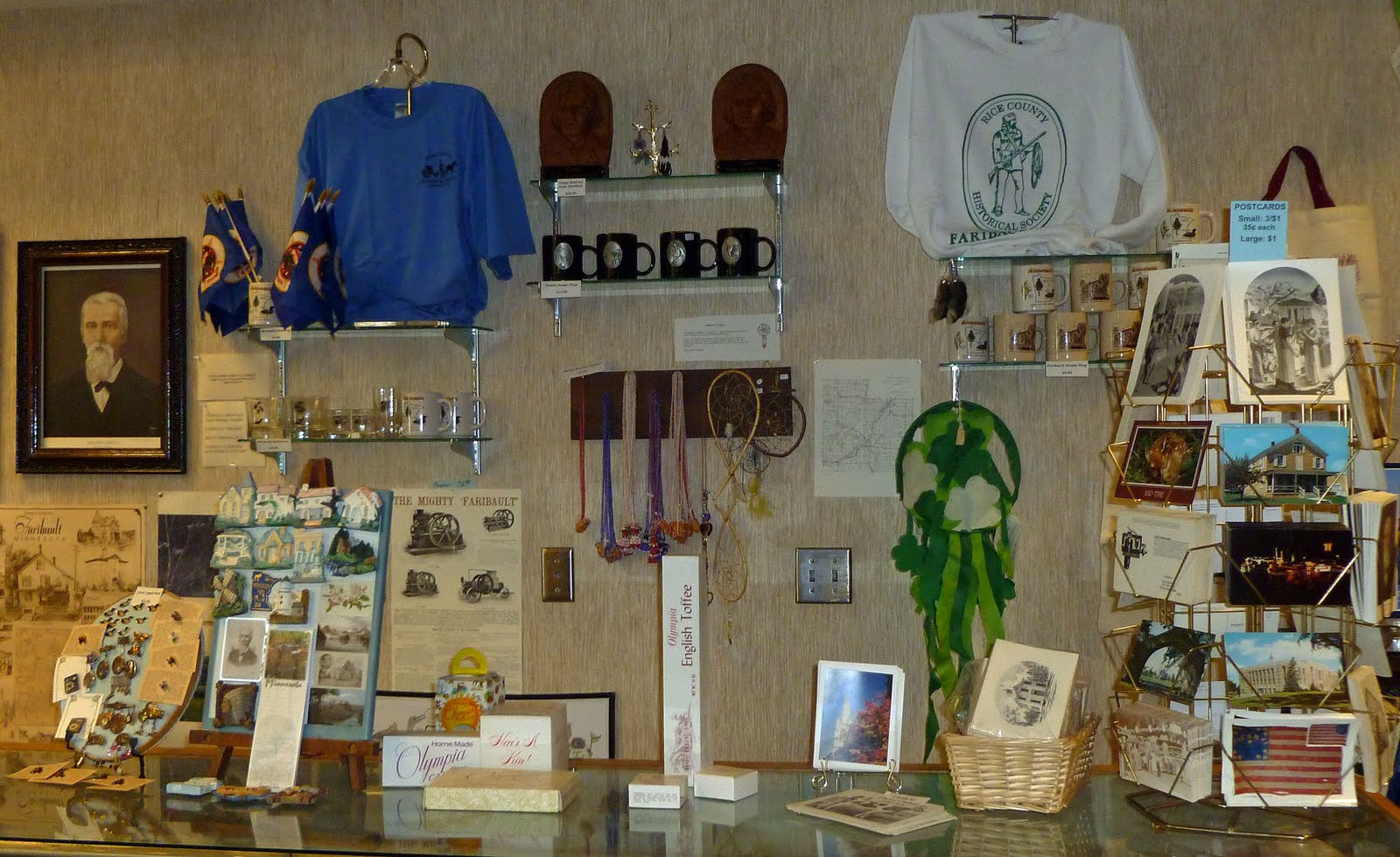
I just finished re-vamping the Rice County Historical Society Gift Shop! We now have all of our merchandise clearly displayed and marked with reasonable prices. We also have a clearance section, which includes VHS and cassette tapes, framed works, and decorative dolls, among other items.
In addition to the clearance rack, the front display also includes our toys. We have toys for all ages, including bow-and-arrow sets, dolls, puzzles and pencil sharpeners!
We then move over to our adult merchandise section. We have sweatshirts and t-shirts in a variety of colors, as well as gifts for everyone on your list.
Jewelry, dried flower arrangements, thimbles and the like are arranged together on a bed of lace, for your shopping pleasure.
Our pins and magnets are newly displayed together above the counter.
We have a variety of items on display, including glassware, postcards and girls' necklaces.
We also now have two stands for our childrens' books, one rack containing coloring books, the other containing children's books.
And finally, our books are now organized by subject, for your browsing pleasure.
We hope you come visit the Rice County Historical Society Gift Shop soon!

Monday, August 1, 2011

Retail

What is the appeal of retail? Though I didn't particularly enjoy my short stint as a Walgreens Service Clerk, I loved working at The Museum of Flight Store, and I continue to enjoy volunteering at the Northfield Historical Society store. I love organizing stock, and keeping numbers, obviously, but somehow there seems to be something more. How is it that I love folding T-Shirts for display, but not so much at home? Why do I like putting things away on the shelves, like it's a race (while still looking friendly to customers, of course)?

I was excited when I was first given responsibility of improving the Rice County Historical Society's gift shop. I've been working on improving the stock selection and display for the past few weeks, and will continue until I am satisfied with it. We've added some new items to the inventory, but we'll also need to continue to reorganize the displays and update prices to market to our customers.

How does a store sell its merchandise? It's selective marketing; similar to commercials. Children's items must be in low visual range, and have bright colors. For non-fragile items, children should also be able to pick up the toys and play with them; not have them hidden away behind glass or out of reach. Books should be organized by target audience, and by subject. Have you ever noticed that bookstores are organized nothing like most libraries?

  • If you go to a bookstore to find a book about apartments and dwellings [613.53], you would probably be surprised to find yourself next to sex books [613.9]
  • Bookstores also usually don't have their fiction simply sorted alphabetically by author. Booksellers know that people interested in murder mysteries are probably not the same people who are interested in manga or romance novels.

The books should be clearly divided by subject, and labeled. Customers don't want to have to use a code to find what they're looking for. Don't even make them use the alphabet! Have clear signage, and let intuition guide your organization. Display the top sellers or new items in an easily visible location. Let these top displays vary in price. Not everyone will want to buy the new leather-bound $50 collectors edition. Also proudly display your $1 bookmarks or booklets.

Happy selling!

Thursday, May 26, 2011

Northfield Townie

This evening, I had a discussion about when you are considered a Townie. Clearly if you are born in Northfield, you are automatically a Townie. But if you move there later, when is the line? Dan had told me that he drew the line at 15 years (at least I think that's what he said...something like that). Though he came up with the number randomly, he's stuck with it ever since. I also had thought about that you're a Townie when you begin to almost take offense at when Northfield is called a “small town,” since compared to the surrounding population, Northfield is a very large town.

Sue believed that being a Townie is made up of mindset and connectedness, much more than time. She moved to Northfield in 1993, but 18 years later, still doesn't consider herself a Townie. Her social life is not in Northfield, and never really has been. She kind of agreed about the idea of taking offense at “small town.” She did NOT take offense when I said it; she rather considers Northfield a small-town herself. Slowly, I began to realize that even though she knows more names and people than I do, and has been in Northfield almost the whole time I've been alive, she's still less of a Townie than I am. But she doesn't really desire to be one either. She is tightly connected to the cities, and likes it so. She also pointed out that she didn't go to either St. Olaf or Carleton, and thereby lacks a major connection to Northfield. By no means are all Townies Carls or Oles, or are all Carls or Oles Townies, being one or the other still does represent a tie to the town, via one of the schools.

I told her that I had often considered the epitome of a Townie to be someone deeply involved with DJJD. She definitely agreed with that point. I told her that I had always considered DJJD to be an exclusive group that had almost a life-long wait-list. To me, it is the only social group in Northfield worth waiting to enter. I told her that the reenactors were the center of the DJJD group in my mind, and it absolutely amazed me when Chip opened the possibility of being a townie in the reenactment for me last week. Sue finally said, “I think that's it. The fact that you were invited shows that you're a townie.” I'm a townie?! Already??

In my interview, when asked “What are you most proud of?” I answered with: “Major accomplishments. Not so much the checking off of things on a list, but the knowledge that I accomplished something.” Though this is very different, it still gives me a similar feeling. I am proud of belonging. I was proud to audition into the St. Olaf Band, but I was also proud to call myself a member and feel the camaraderie of the group. Likewise, I was excited to begin volunteering at NHS in 2008, but now I am proud to have even just one person consider me a part of the group; a Northfield Townie.

Other Northfield Townies – What are your thoughts? What does it take to become a Townie? What does it mean to be a Townie?

Thai Food

After work today, Sue and I went to a Thai restaurant in Faribault. After looking through the menu for a minute, the waiter asked what we were thinking about ordering. I said I was thinking about the pineapple fried rice. He said, “Might I recommend the Phad Thai?” “When I go to Thai restaurants, I sometimes try not to order Phad Thai, because it's what everyone gets.” “Well, our chef makes an excellent sauce, whereas fried rice, you can get at any Chinese buffet.” “Uhh, right. I'll think about that.”

What do you say to that? Asian restaurants in non-Asian areas are so different from Asian restaurants in areas with a high Asian population. “They assume you know nothing,” as Sue put it. I ended up ordering another dish; not fried rice or Phad Thai. It was good. But really, I wonder what the chef would have thought about his waiter comparing his fried rice to Joe Schmoe's Chinese Buffet fried rice. I really think the fried rice would have been better than that; I would give the food pretty good marks overall. Also, after I went through the usual “Yes, I really want TEN out of FIVE stars” routine, and he brought the food, he reminded me that if it wasn't hot enough, I could use “that.” He pointed at the condiment display on the table. I said “Yes, I know Siracha.” He said, “No, I meant that.” “This?” I said as I pointed to the jar of chili oil. “That's chili oil. That has fat. Siracha doesn't.” He didn't know what to say. I don't think he knew what either one was, though he seemed vaguely aware that chili oil was hotter (at least per ounce) than Siracha.

Wednesday, May 12, 2010

What is Archiving?

What is an archivist? What is archiving? I get these questions all the time. It's what happens when you have a passion for something obscure. Sometimes I respond with fun answers like, "I organize old stuff" or "I work in the basement of a museum." The truth is, the job of an archivist is very complex, and it depends what type of archive you work in, what type of job you might focus on. I have talked to many different archivists at many different archives, who have all given different answers to the question. The first archivist I interviewed (at The Museum of Flight) told me she "managed 2-dimensional artifacts." Generally, archiving refers only to pictorial, text, and media, reserving the term "collections management" for the care of an entire museum collection encompassing both archival materials and objects.

When I interviewed an archivist at the National Archives in DC, she explained that they divided their staff by processing, preservation, and reference. She herself had started in processing, found that to be boring, and then moved into reference, where she felt more at home as a strong extrovert passionate about history.

Through my own work and experiences, as well as these and other informational interviews, I have come up with my own perception of how the field of archiving is divided. Each time I interview a new intern, I explain this to them, in order to help chose a project that they will like the most.

Accessioning is the first step in the archival process. Accession records tell the custodial history (who previously owned the material), and a brief description of what is coming into the repository. Accessioning is the step where the items receive their identification number, called their accession number. In the numerical system we use at NHS, also common in other museum archives, this number consists of three parts. The first part is the year in which it is accessioned. Hopefully this is the same year it came into the repository, but unfortunately this is not always the case due to extreme backlog or previous lack of record.

The next step in the archival process is called "processing." This is where the most work, by far, occurs, and also the point at which the accession number is actually attached to the material. This work varies substantially depending on the type of material being dealt with.

Archival processing, which generally refers to text documents, often just consists of inventorying. NHS receives a very wide variety of types of collections, so it is difficult to give a simple description of what archival processing usually entails. At the end of processing, an archival collection should be neatly housed in archival folders, which are placed in a logical order in one or more archival boxes, all of which are properly labeled. In most cases, the collection will require some sort of written inventory (usually a list of folder titles/numbers). Each collection will require a different amount of re-foldering and/or re-organization. Provenance is the idea that a collection should be kept in its original order. This is only sometimes applicable at NHS; many collections come to us with no existing order, in which cases we must establish a logical order for the collection.

Photographs are the most complicated by far. They cannot be represented by simply a name; all require a fully descriptive title. A picture says a thousand words, right? So how does one manage them? First of all, every image must be given a number so that it can be kept track of. Second, every photo must be put in a proper sleeve to protect it from fingers, as well as from the surrounding air. The photos should be arranged in the most logical order, like archival collections, and housed in folders and/or boxes. An inventory must be made, and ideally, all images will also be scanned.

I think of media as falling somewhere between object and archive. A video has a proper title and creator, but generally requires little more work than housing and inventory. Collections with mixed forms of media can be hard to properly house (cassettes, VHS tapes, DVDs and CDs often come in collections together). Usually, the whole collection will be arranged in the most logical order (usually chronologically or alphabetically), given sequential accession numbers in that order, then separated by format for proper housing.

Collections processing is generally the simplest, because objects usually come in small donations. The object(s) must be described, and then housed with acid-free paper, or whatever packaging is appropriate, labeled, and placed in the collections room. However, some collections can be quite large. For example, an intern is currently working on processing a collection containing 1000's of pins. Each pin needs to be labeled with its individual accession number, housed in an archival box, and then a complete inventory of the entire collection must be made. We also are slowly making it standard procedure to photograph objects in the collection in order to have a visual record of the object.

The line between processing and preservation can be a fine one, but there are distinct enough differences so that it deserves its own category. At NHS, we don't do a substantial amount of preservation work. For example, my campaigning for a freezer is a sort of preservation effort, but the work done to prepare the negatives to go into the freezer would all be considered processing. Generally, I like to think of preservation as anything that requires much scientific knowledge or skill, beyond putting photos in sleeves or objects in paper.

Reference is the applicable side of archiving. Archives are organized for the purpose of helping researchers find the information they are looking for, and archivists are there to help. Reference generally works in two ways: researchers come in and do their research with you assisting and supervising, or they ask you to find something for them. Since we don't have a "reference archivist," NHS runs its archives on an appointment-only basis. When a researcher comes in, I pull the materials they are interested in, which usually end up being folder-level, often from the subject files, but sometimes from other collections. A few times a week, we get research requests either by phone or email. Sometimes a researcher is looking for a specific fact, other times they are looking for generic "information." The latter is much harder, because they often don't want to sift through a collection themselves, so I have to, for example, pick out exactly what pages they might be interested in and scan them.

The archival process is fairly simple in concept, but in reality, it is very multi-faceted and always interesting!

NHS Archiving Blurbs

Here are two bits I've written about my work at NHS for the CEL.

Project (150 words):
I am the archivist at the Northfield Historical Society, which involves: accessioning, processing, conservation and reference. I also recruit, interview and supervise the interns working in the archives and collections. When research requests come in, usually by phone or email, I find the information they are looking for, and I also assist researchers who come in to use the reference room. This semester, I have written procedure manuals covering all regular archival procedures as well as introductory materials for new volunteers and interns.

Impact on NHS (150 words):
In my two years working for NHS, I have made a substantial impact on their archives. I came in just as their previous archives volunteer had to leave suddenly for health reasons. Over the time I have worked there, I have taken on more projects and responsibilities, going beyond the day-to-day managing of the archives, to working both backward and forward: eliminating the backlog of work, as well as creating a systematic means of continuing to manage the archive after I leave. I have made efforts in recruiting more interns at St. Olaf in hopes that they will help to continue the smooth management of the archives.

Impact on self (150 words):
My work at NHS has had a tremendous effect on my professional development. I came into NHS two years ago, knowing I wanted to be an archivist, but not knowing exactly what the job of an archivist consisted of. I since have taken over the full management of an entire archive. I mostly paved my own way, slowly learning how to answer my own questions and work more and more independently. Since I started at NHS, I have volunteered in other archives around the country, but none of these experiences has been any more fun, rewarding, or meaningful than my internship at NHS.


My name is Alicia Reuter, and I am a senior German major with concentrations in linguistics and management studies, but I am an archivist. I have always loved museums, but after my sophomore year, I realized archiving was where my passion truly lies.

I began working at the Northfield Historical Society at the beginning of my Junior year, and absolutely loved it! At Olaf, many of us get trapped in the little bubble on the top of the hill, and during my first two years, I felt kind of suffocated. But then I discovered life off-campus, at NHS. I started with working on a scanning project 4-6 hours a week. It was refreshing to get off-campus a few hours every week. After I finished that project, I gradually started working more, doing anything and everything in the archive. NHS began to feel even more like home than Olaf! The people there are nice, and it is a fun and academic environment. The experiences I have gained and the skills I have acquired at NHS have prepared me very well for my future career as an archivist. This semester, I arranged my schedule so that I can spend all my time during the day working there, through internships and independent studies. The experiences I've had at NHS are unforgettable, and will be a springboard for the rest of my life.

Feel free to contact me (reutera@stolaf.edu) to find out more about how you too can get involved!

Sunday, February 14, 2010

St. Olaf Band Tours Japan

The St. Olaf Band toured Japan in January-February 2010 as a part of the course "The Arts and Culture of Japan." We spent most of our time in and around Tokyo, Hiroshima, and Kyoto.
Okonomiyaki, a Hiroshima specialty. This is basically an "everything" okonomiyaki.

They served us "American" food.
"American" food? Sure.
But Japanese sake. They practically shoved it down our throats.
We had a celebrity farewell after our first concert!
Mystery meat on a stick. Octopus? Bought at a truck stop.
Gakugeikan danced in their show.
The A-Bomb Building in Hiroshima.
The mound in the Hiroshima Peace Park was made from ashes of those burnt in the blast.
Visitors come bearing 1,000 cranes and/or art for peace made out of cranes, which are displayed at the Children's Memorial.
The Children's Memorial.
It is said that this flame is not eternal, but will go out when there are no more atomic bombs left in the world.
Look through the Peace Arch to the Flame to the A-Bomb Building.
The outfit a boy was wearing through the explosion.
A Kyoto suburbial neighborhood.
Saitama Sakae demonstrated Japanese sports for us, including archery,
and sumo wrestling.
For lunch one day, we stopped at a mall that reminded me a great deal of Universal's CityWalk, except it had a pagoda.
There was a dance concert going on, which was really cool. It was also fun how, usually, Japanese people do not show enjoyment during performances, but the drummer in the front in this picture was really having a good time.
Our room in the ryokan, the traditional Japanese hotel.
The group room, where we had meals, class, and No Talent Night.
My new pink yukata that I got for 500 Yen (~$5).
I also got this more expensive one. I wish we could wear yukatas every day!
We had a 7-course traditional Japanese dinner. It was amazing!
Which included grapefruit for dessert.
Japanese dogs wear clothes. This dog was super cute, cuddling in its Sesame Street hoodie in its blankie on the floor.
Shopping area in Asakusa, Tokyo.
Only in Akihabara, can one find a ridiculous collection of cute SD cards. I kind of wanted one.
Did you know that Tokyo also has an Empire State Building? Well, now you do.
Since in Japanese, L and R are the same letter, they often get confused in English, even written English.
Eirik from Norway, grilling us some yummy okonomiyaki.
My tiny room at the hostel/hotel, in Tokyo.
This bear is pointing to the subway doors, saying, "Don't get your finger caught!"
I learned some kanji on my trip. This menu included some important ones: 大 means big, and 辛 means spicy.
Japanese toilets are famous and complicated. They have a) heated seats, b) built-in bidets, 
c) music or other sounds, automatic everything. They can't be sufficiently described - you just have 
to go check them out!
Some trains on the subways are for women only late at night.
These textured yellow strips in and around subway and train stations guide blind people where to go.