Showing posts with label Museums. Show all posts

Tuesday, August 9, 2011

RCHS Store

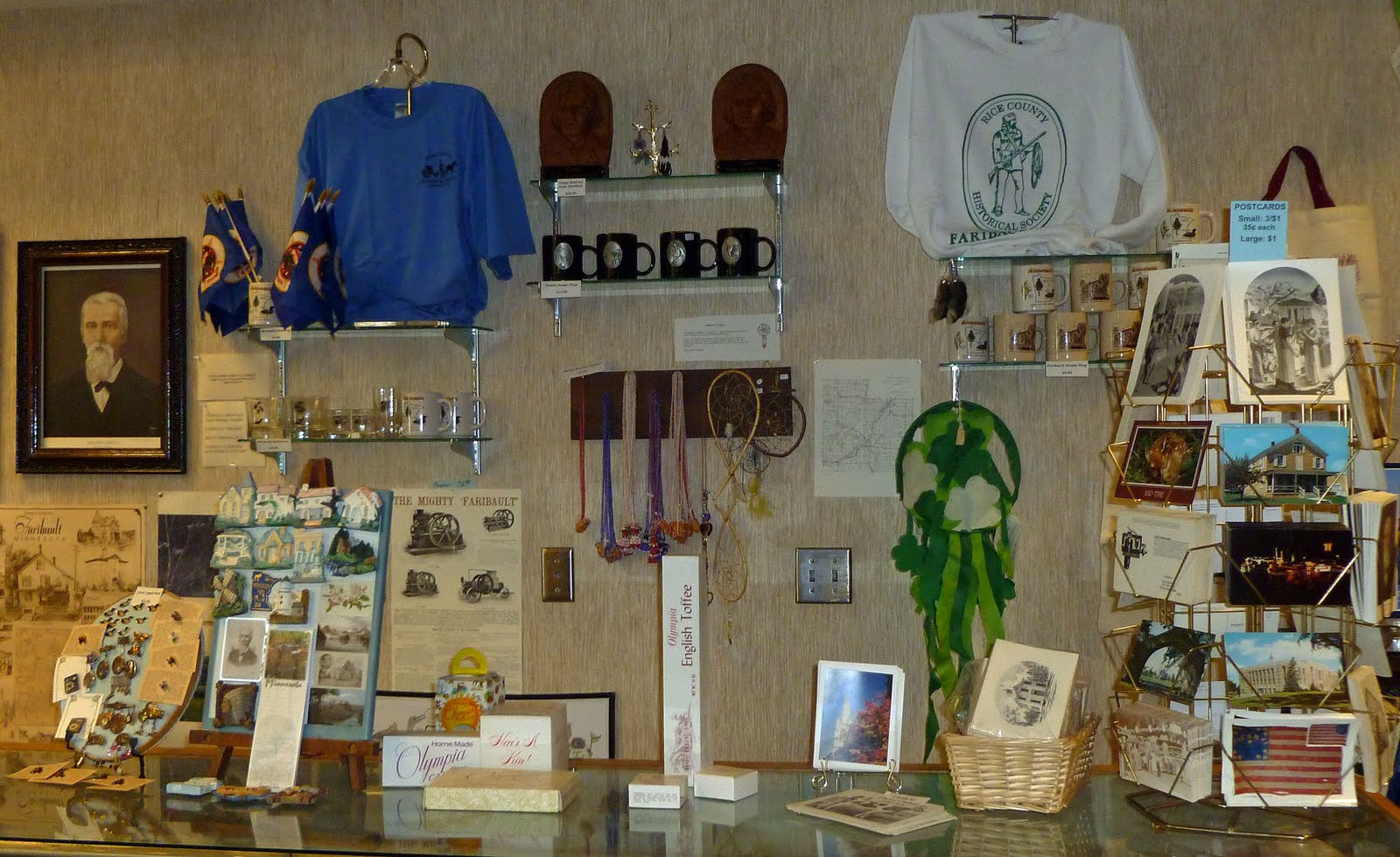
I just finished re-vamping the Rice County Historical Society Gift Shop! We now have all of our merchandise clearly displayed and marked with reasonable prices. We also have a clearance section, which includes VHS and cassette tapes, framed works, and decorative dolls, among other items.
In addition to the clearance rack, the front display also includes our toys. We have toys for all ages, including bow-and-arrow sets, dolls, puzzles and pencil sharpeners!
We then move over to our adult merchandise section. We have sweatshirts and t-shirts in a variety of colors, as well as gifts for everyone on your list.
Jewelry, dried flower arrangements, thimbles and the like are arranged together on a bed of lace, for your shopping pleasure.
Our pins and magnets are newly displayed together above the counter.
We have a variety of items on display, including glassware, postcards and girls' necklaces.
We also now have two stands for our childrens' books, one rack containing coloring books, the other containing children's books.
And finally, our books are now organized by subject, for your browsing pleasure.
We hope you come visit the Rice County Historical Society Gift Shop soon!

Monday, August 1, 2011

Retail

What is the appeal of retail? Though I didn't particularly enjoy my short stint as a Walgreens Service Clerk, I loved working at The Museum of Flight Store, and I continue to enjoy volunteering at the Northfield Historical Society store. I love organizing stock, and keeping numbers, obviously, but somehow there seems to be something more. How is it that I love folding T-Shirts for display, but not so much at home? Why do I like putting things away on the shelves, like it's a race (while still looking friendly to customers, of course)?

I was excited when I was first given responsibility of improving the Rice County Historical Society's gift shop. I've been working on improving the stock selection and display for the past few weeks, and will continue until I am satisfied with it. We've added some new items to the inventory, but we'll also need to continue to reorganize the displays and update prices to market to our customers.

How does a store sell its merchandise? It's selective marketing; similar to commercials. Children's items must be in low visual range, and have bright colors. For non-fragile items, children should also be able to pick up the toys and play with them; not have them hidden away behind glass or out of reach. Books should be organized by target audience, and by subject. Have you ever noticed that bookstores are organized nothing like most libraries?

  • If you go to a bookstore to find a book about apartments and dwellings [613.53], you would probably be surprised to find yourself next to sex books [613.9]
  • Bookstores also usually don't have their fiction simply sorted alphabetically by author. Booksellers know that people interested in murder mysteries are probably not the same people who are interested in manga or romance novels.

The books should be clearly divided by subject, and labeled. Customers don't want to have to use a code to find what they're looking for. Don't even make them use the alphabet! Have clear signage, and let intuition guide your organization. Display the top sellers or new items in an easily visible location. Let these top displays vary in price. Not everyone will want to buy the new leather-bound $50 collectors edition. Also proudly display your $1 bookmarks or booklets.

Happy selling!

Wednesday, May 12, 2010

NHS Archiving Blurbs

Here are two bits I've written about my work at NHS for the CEL.

Project (150 words):
I am the archivist at the Northfield Historical Society, which involves: accessioning, processing, conservation and reference. I also recruit, interview and supervise the interns working in the archives and collections. When research requests come in, usually by phone or email, I find the information they are looking for, and I also assist researchers who come in to use the reference room. This semester, I have written procedure manuals covering all regular archival procedures as well as introductory materials for new volunteers and interns.

Impact on NHS (150 words):
In my two years working for NHS, I have made a substantial impact on their archives. I came in just as their previous archives volunteer had to leave suddenly for health reasons. Over the time I have worked there, I have taken on more projects and responsibilities, going beyond the day-to-day managing of the archives, to working both backward and forward: eliminating the backlog of work, as well as creating a systematic means of continuing to manage the archive after I leave. I have made efforts in recruiting more interns at St. Olaf in hopes that they will help to continue the smooth management of the archives.

Impact on self (150 words):
My work at NHS has had a tremendous effect on my professional development. I came into NHS two years ago, knowing I wanted to be an archivist, but not knowing exactly what the job of an archivist consisted of. I since have taken over the full management of an entire archive. I mostly paved my own way, slowly learning how to answer my own questions and work more and more independently. Since I started at NHS, I have volunteered in other archives around the country, but none of these experiences has been any more fun, rewarding, or meaningful than my internship at NHS.


My name is Alicia Reuter, and I am a senior German major with concentrations in linguistics and management studies, but I am an archivist. I have always loved museums, but after my sophomore year, I realized archiving was where my passion truly lies.

I began working at the Northfield Historical Society at the beginning of my Junior year, and absolutely loved it! At Olaf, many of us get trapped in the little bubble on the top of the hill, and during my first two years, I felt kind of suffocated. But then I discovered life off-campus, at NHS. I started with working on a scanning project 4-6 hours a week. It was refreshing to get off-campus a few hours every week. After I finished that project, I gradually started working more, doing anything and everything in the archive. NHS began to feel even more like home than Olaf! The people there are nice, and it is a fun and academic environment. The experiences I have gained and the skills I have acquired at NHS have prepared me very well for my future career as an archivist. This semester, I arranged my schedule so that I can spend all my time during the day working there, through internships and independent studies. The experiences I've had at NHS are unforgettable, and will be a springboard for the rest of my life.

Feel free to contact me (reutera@stolaf.edu) to find out more about how you too can get involved!

Tuesday, December 1, 2009

Home

Today, I ran to the museum to quickly grab the metadata files so I could work on them later. I told the receptionist I just needed to grab the digital files so I could "do my work from home." It felt very weird to say. NHS feels more like a home to me than a work, and my "home," aka school, feels much more like work.

Thursday, October 1, 2009

NHS Internship Reflection (from Independent Study/Internship January 2009)

After my last day of work for interim, I sat at Hogan Brothers, looking across Division at the First National Bank – the Scriver Building. NHS has become my home, of sorts. Chicago puts it best “You should know, everywhere I go, always on my mind, in my heart, in my soul. You’re the meaning in my life, you’re in inspiration.” It may sound crazy, but I literally love museums, the passion, the learning, the artifacts, the history, the people. No matter what aspect of museum work it is, it still holds an intense flavor of passion for learning, unlike any school environment. When I returned to The Museum of Flight over Christmas break, I wandered around, excited as could be. My coworker sighed to my mom, “you can take the girl out of the museum, but you can’t take the museum out of the girl.”

In working at NHS, I learned so much about Northfield, without ever intending to. I learned the history of the Scriver Building and the James Gang, of course, but I also learned about countless other aspects of Northfield history through pictures. Before September, I hardly knew the way from St. Olaf to downtown to Carleton. I don’t think I even knew the 4th Street Bridge existed. There is a sense of fulfillment I have gotten from working here. I know the area now; I know where I go to school. I couldn’t say I knew that before.

Although the knowledge of history is what is most easily shown to others; I can give random facts about Northfield history and amuse or impress others with it; it is not what has been the most meaningful outcome for me. I have learned about archiving. I learned what it really is. I knew before that I wanted to work with cataloging and inventorying, but I never knew exactly what it would be like. I have learned about accessioning, metadata, Chenhall’s, scanning, Past Perfect, Content DM…most of those words would have meant almost nothing to me mere months ago.

It has been (and continues to be) an amazingly unmatched experience to work my way through the archives. My first assignment after Dale Ness (simple scanning and data entry of 495 photos) was to “pick out pictures of education in Northfield.” I went through the cabinet, not knowing at all what I was looking for, or what the heck this whole project was. Jeff (archivist at St. Olaf) had told me that NHS was doing something new, this online collaborative project. More than that though, it was all a mystery. We didn’t really know what we were doing at the beginning. I inventoried and scanned…approximately. The NHS metadata sheet, honestly, was a mess, especially compared to NPL and RCHS, simply because I didn’t know what I was doing. I figured it out as I went along, and finally was able to finish scanning and inventorying RCHS’ contribution of a couple hundred images in two days. I have learned about what happens in archives, how complicated it really is, and how the computer database systems really aren’t perfect yet, so the ins and outs of the whole process really must be learned. I have begun to really keep an eye out for new ideas in archiving that I could bring to NHS.

As was often said in my Arts Management class last semester, you always learn as you go. On-the-job training is the only kind of training you really get in the arts world. That is indeed true, and nothing I could have ever learned in any other situation could have equaled what I have learned in the past five months, especially January.

It has also been an amazing experience just being around the Historical Society! When I was in MWF 10-12, I got the opportunity to meat Joan a few times before she left, and I also met Mrs. Ripley. However, in working mostly full days for a month, I have gotten to meet/know researchers (Sue), archivists (Sue), Gloria at the front desk, the accountant, and many others. I have gotten to actually see a larger part of the workings of NHS, which is exactly what I had hoped. It is true, I do not exactly want to run a small historical society, but ideally I would work at a small-medium sized museum, and if nothing else, I would be aware of the different aspects outside of focusing directly on archives. This is why I want to go into museum studies and not directly through a library science/archival track. Archives are awesome, rare book collections are impressive, but the atmosphere of the museum is really what makes it all come alive.

Whenever I see a need, I am drawn to fix it. The photograph cabinet is a good example: there is so much potential in there, but it is not particularly organized, not kept track of, and about 40% non-accessioned. It is going to be almost painful to only come 6 hours a week. The complete inventory of the photograph cabinets will be a very long and tedious process, and I can’t wait until I can see it completely through.

I am a planner; I am future-oriented. I am always looking toward something or other a few weeks or months away; I am rarely content with the present. However, even though I would be heading to California over interim break, or diving back into Latin second semester, going to finally see the Smithsonian in April…I was content to live in the present. I did not want the future to come. My parents and friends have heard it far too many times; I did not want interim to end! They thought it was crazy, but it is true. I am still sad that I won’t be able to go to NHS on a daily basis (until perhaps senior week!). It feels strange writing this – my time at NHS is by no means over, so I should use the present tense, but it will feel like I am indeed leaving, simply because I will only work on Thursdays, instead of every day of the week. I just mean to say, this has been, and will continue to be, the best not only preparational, but also one of the overall best experiences in my life up to this point.

Wednesday, September 30, 2009

Museum Reviews (from my trip to Germany, Tromso, Norway and London, England in January 2008)

Roman Museum
The museum was very interesting; I thought the most interesting parts were the grave stones, which there were quite a lot of. I could understand a fair amount of the Latin, although it was a bit rusty. It was nice that they had transcriptions and translations into German. Some of the information was also translated into English and French, but only some. I understand to an extent why they only translated some of it, but it would have been nice if everything was reliably translated – I heard a lot of English-speaking tourists there. The museum was set up about exactly between that of an art museum and that of a history museum. Although there was almost no Roman art on display, everything was artifacts, there wasn’t anything interactive or chronological. It was organized mostly, by type of artifact. This was, in a way, nice, however, I would have preferred it to be chronologically organized, if it would have been possible, because then I probably wouldn’t have gotten a headache so fast from reading tombstone after tombstone. Another thing that disappointed me, was the lack of text. There were captions for most artifacts, however, there were almost no signs that explained the Roman history. I couldn’t find one sign that said the date of when Rome conquered Colognia, much less how. Near the end of our visit, Micot asked a docent about pictures (I was farther away, so I didn’t completely hear his question). Anyway, she pointed him to a room, where there were pictures of the excavation. That was less interesting to me, but it was a nice, information-filled room. However, it was totally hidden! There was a sign on the door, saying what was inside, but if one wasn’t looking for it, they would completely pass it by! When we left, we had to squeeze through the entrance way. They had all but about 3’ roped off from the entrance hall to the museum. There was a guy standing there checking tickets. OK, I understand why they did that; but really, how many people are going to try and walk in without a ticket? How hard would it be to control 8’ instead of 3’? The gift shop, also, was puny, and practically non-existent.

Lindt Chocolate Museum
This was a much bigger museum, and also much more crowded. It was very crowded. True, the factory/museum was on a tiny island in the Rhine, but I believe they could have improved their crowd management techniques. The direction of flow was very clear. The exhibits started out with a history of the cocoa bean, how it is harvested, how it came to Europe, etc. After this initial background on what chocolate is, we came into a huge room with chocolate machines. I’m pretty sure that only about half of the machines there were functional (the actual factory must have been on the other side of the building somewhere), but there was somebody handing out free samples of melted chocolate on a stick, and there were also people actually making and packaging chocolate behind Plexiglas walls, which had all the explanation needed about what was happening. There was a stand where they were selling truffles for 0.5€ each, and Hannah thought that was insanely expensive. After we lagged in this room for forever, we continued up to more exhibits. These exhibits explained the history of chocolate in Europe. Did you know that before chocolate bars, people drank hot chocolate as a luxury drink? Then hot chocolate would be a normal drink, and THEN chocolate bars came. There were lots of interesting artifacts; old candy wrappers, old advertisements, etc…up through interesting collections of new artifacts, including 500 Kinder Egg surprises, and a Kit-Kat bench. This chain of exhibits plopped us back in the factory room, and we were forced to go back through the first exhibit hall, to come back out into the lobby. This is what museums should always avoid! Backwards traffic flow! I really don’t think it would have been hard to built a bridge going directly to the exit (bridges connected all the exhibits with the factory room). From the lobby, there was a café (I would have LOVED to try the hot chocolate, but the Trippes, I’m positive, would have found that a complete waste of money, so I didn’t even ask). The gift shop was huge; it had every sort of fancy Lindt, Hussel, and Mozart chocolate. The Christmas candy was 50% off, so I got a cinnamon chocolate bar, and Christmas truffles for 3.5€. However, as I was about to grab the cinnamon bar, a store clerk steps in front of me, and organizes the display for a good minute, as I give up trying to reach around her for the chocolate. We’re specifically told not to step in front of people to fix the displays! For good reason! I also found it strange, that they had a collection of totally random metal sign things, that had nothing to do with chocolate (the Trippes bought 3 of them), yet had no books or educational things about chocolate.

Polaria (Tromso)
The museum was really quite good, despite being quite small. The main exhibit area had nicely made displayed about polar exploration and global warming. There were also a handful of interactive exhibits, including a quiz of museum content (I got 60% before going through). Everything was in Norwegian and English, and about 90% also had German. The main part of the museum seemed to be the panoramic video. Every half hour, they showed 18-minute videos of arctic scenery and animals, and played music to go along with it. It was really nicely done. The theater leads you into another exhibit about arctic animals. This exhibit reminded me of the Titanic at PSC, because it had fake icebergs all over, and also had appropriate lighting and floors. From here, you came to a small aquarium. There was a seal, and also about 5 medium-sized tanks with various other kinds of animals.

Since the museum was so small, $13 seemed quite steep to me, but the museum was very well done. It had plenty of interactive displays and activities for kids, and the diagrams were all very well presented. This was also the first completely bi/trilingual (other than in Luxemburg, where there are 3 official languages) museum I’ve seen. Most museums only translate some things into English, and often will shorten captions as well.

The gift shop was very cute, and had a very nice selection of kid and adult gifts, as well as some Tromso things. The only bad thing was that it seemed very squished, when the exhibits were quite open. I didn’t look at the café upstairs.

Polar Museum
The museum apparently was known to be a destination where tourists “shouldn’t go,” because some Americans got freaked out, and reported some exceptionally gory parts of the museum. I was ready for anything, but I never saw anything exceptionally bad.

The first room I went into (which actually was supposed to be the last room) was completely in English, about the explorer who found the Northwest Passage. There was a TV playing the PBS documentary on it. It was interesting, although small. To get to the min section of the museum, you had to go through the gift shop. There were a series of different rooms about polar exploration and hunting. There were lots of mannequins, which were a bit freaky at times, and some of them were stabbing animals or whatever, but nothing was particularly gory. What I found weird though, was that the entirety of the main exhibits was in Norwegian, except for the tags on artifacts, which were mostly translated into English and German. These are the things that are usually left un-translated. I didn’t read that much of the information; I got there at 2:15, and the museum closed at 3:00, so I didn’t want to be too slow. The detail of the models and scenes was so awesome, that it seriously distracted (me, at least) from the massive amounts of information on the walls. It’s really nice to have spectacular visuals, but somehow it seemed too much.

British Library
It was remarkable! There was a courtyard with a café, and then inside, they quickly looked through bags. I’m not exactly sure what they were looking for though. The galleries were cool. There was an exhibit on Avant Garde, which talked about how it was represented in different cities in the era preceding WWI. There was also a very impressive collection of stamps on display. However, I DEFINITELY agree with Rick Steves about the best part of the library. The collection of original documents is simply remarkable! There were plenty of texts I didn’t care about, but there was an awesome collection of amazing artifacts: the original copy of Beowulf in Old English, the original manuscripts of Beethoven’s 9th, Edgar’s Enigma Variations, a Mahler Symphony, and many others. They also had Beethoven’s tuning fork, which had been passed down through generations of musicians, including Holst, and eventually (actually, relatively recently), it landed in the museum. There were also numerous significant copies of the Magna Carta, including one that was so old, it was almost completely illegible. It’s paper from 1215!

British Museum
The British Museum is huge! It is the largest museum in London, housing LOTS of artifacts, which I swear, are mostly out of stone. The map cost ₤2, and once I had studied it, I could generally figure out where things were. However, it was insanely crowded. February isn’t even tourist season! I looked mostly at the Greek, Roman, and Egyptian things, seeing of special note, lots of carvings from the Parthenon, and the Rosetta Stone. However, I was left unsatisfied. There was simply too much on display. I can appreciate massive museums for their educational value, especially to art historians, anthropologists, etc, but for the general public, they are simply boring. They seem to reduce the value of everything, simply by having so many things. The library gallery was impressive, because it was reasonably small, and only had certain things on display. For example, if I went to a museum with most or all of Beethoven’s original manuscripts, the novelty would quickly wear off. However, when there are only a few significant and well captioned artifacts, it is much more impressive. The British Museum, like the Louvre, is simply a must-see because it has one or two top-level, world-famous artifacts, and because it is simply so big. However, I doubt that the majority of the visitors actually care about the majority of the things that they see. They just take up space, won’t budge when you want to pass, and hurt the artifacts by exposing them to insane amounts of flash photography. Another thing is, that although I respect their idea of regular museum rotation, two Roman exhibits were closed for rotation or whatever. Not pleased.

Natural History Museum
It was amazingly castle-esque from the outside, and on the inside, it seemed like a dinosaur castle, because the entryway was stone with stained glass windows, and a dinosaur skeleton right in the middle.
I started out by going through the human biology exhibit, which turned out to mostly be focused on development. It always amuses me how European museums don’t shy away from sex. Almost all of the diograms/etc were naked, and some were amusingly graphic. To my enjoyment, the exhibit continued from pregnancy, birth, growing, adolescence, hormones, etc, to neurology and even some psycholinguistics! The exhibit was very visually stimulating, interactive and educational. My only complaint is that it did not follow a sequencial path, so I could not be sure if I’d seen everything.
I went for a quick tour around the animal exhibits. They had a ton of skeletons and stuffed animals, and they even had a caption that said that whales’ penises are 3m long. European liberalism again.
My favorite exhibit was the ecology one. It followed a path, and set the mood. It was dark, and really conveyed the message that ecology depends on humans to stay alive. After that, I went into the geology exhibits. They had a very impressive display of rocks and minerals. The exhibit on volcanoes and earthquakes was good, but personally, I am sick of going to earthquake exhibits for people who have no idea what an earthquake is (examples: Minneapolis SC, Luxemburg SC, Tromso Museum). There was a corner where they had a set-up where you could “experience” an earthquake, and it was so crowded, that I couldn’t pass through, so I just walked out backwards through the exhibit.
Although this museum too was very crowded, it was big, but also manageable, and very nicely interactive. They had one or two exhibits that cost extra, including one on arctic exploration, which was advertised everywhere. However, after being in Tromso, I believe that their facts were a bit off. “Can you surive temperatures of -20?” Welcome to Minnesota. -20C~-3F. “Can you survive 6 months of complete darkness?” MAYBE you’d get that at the pole. But seriously, how many people go THAT far. Also, in the winter, I would bet it’s much colder than -20C!
The dinosaur rooms were free, like the majority of the museum, but apparently were so popular that they needed to have a line, which looked 30-60 minutes long. So I didn’t see the dinos. Big deal.

Science Museum
That wins my vote for best museum…ever. I started with the gift shop, and even from there, they had me. They had two gift shops, across the hall from each other – one with books, the other with toys, gifts, etc. There was a fair amount of overlap with us on the space toys, but this store was more awesome than our store and the PSC store combined. It was comparable to Top 10 Toys in both size and variety, but they also had things for adults, including these “dryer balls” which should be used instead of dryer sheets, and apparently reduce drying time by 25%.
Finally, I dragged myself into the exhibits. The opening gallery was about space exploration. There was no track to follow, but it was an open gallery, so you could see well where you had been. It was set up very well, but again, I find it amusing when I country who has designed one rocket ever, has an exhibit on space exploration. From what I could tell, they had 2 real artifacts: the Apollo 10 capsule, and a payload that had been on the shuttle.
The next room though, was utterly stunning. Two airplanes hang suspended in the air, the room is filled with boats, cars, engines, and other artifacts. The general theme is the evolution of “technology,” but the inspiring spread-out display style actually enhanced the cohesion of the artifacts.
Upstairs was another gallery with airplanes. This exhibit was similar to what it would be like if TMOF opened out the entire Red Barn, and summarized the entire history of flight there. It was a combination of the gallery and exhibit style of layout.
I decided to go on a simulator. The museum has a 3-D IMAX, 3 simulators, and a set of more arcade-style simpulators. For students, it was only ₤1.5. It was a “roller coaster ride through space,” which turned out to be a bit pathetic, but I guess it was decent for what it was.
Like the dino exhibit at the NHM, the interactive exhibit here had a line to get in. This probably was for the better, but for me, who just wanted to look, it was a bit inconvenient, so I didn’t go in. Instead, I went upstairs to the medical exhibits. This section was much bigger than I had anticipated. They had an impressive collection of ancient and modern medical instruments. They also had excellent explanations for everything. In the second room, there were life-size displays of doctors offices from ancient times up to now. It was all extremely interesting. I had to force myself to leave around 5, so I could check out Harrods before it closed at 6.

Imperial War Museum
The store was just a bit smaller than that at TMOF, but had a very similar selection. It was less visually and thematically organized, but practically organized, which I preferred. There was a lot of overlap with what we carry, but with an addition of all things camouflage.

This is my kind of museum! In the front, there was a temporary exhibit on Dan Radcliffe’s new movie about WWI. I touched Dan’s chair! :-p From there, you came into the gallery. This is my kind of museum! Airplanes and tanks everywhere. Airplanes hanging from the ceiling make you feel relaxed and free…or maybe that’s just me. The gallery was not made of glass, and was less than ½ as big as the Great Gallery, but it had the exact same effect.

From the gallery, there was access to all the other exhibits. The museum was not packed, but it was filled with school children in uniform. I’m used to that environment at TMOF, and I love it. There was a little submarine exhibit, which was cute and interactive, but that was pretty much the only interactive exhibit in the whole place…but boy, did they pull it off! The first exhibit I went through was called the “Children’s’ War,” which was about how children experienced WWII. Very informative, with interesting artifacts, and awesome mock-up displays.

Next, I went through the WWI&II exhibits. These had a well-marked-out path (like everything except the gallery). However, it was a bit of a maze, and I couldn’t help but wonder how long it took employees and volunteers to learn their way around. This exhibit was also excellently done – my favorite were the massive amounts of mannequins in uniforms in cases. In the WWI section, there was a “trench experience.” I went in, but practically ran through. That thing is freaky!!! Ours is for complete whimps in comparison! Since it seemed likely that they would have a live theater program, I was just waiting for one of the mannequins to pop out at me – that’s what they do at TMOF! In the WWII section, they had a blitz simulation. Here, they warned “No unaccompanied minors, people with anxiety disorders, etc.” But although this was cool, I didn’t find it very scary at all.

By this point, I had been through about half of the exhibitions, and I was just waiting for the exceptional exhibits to end, and the rest to be just normal quality. No. Everything here is absolutely perfectly done.

The holocaust exhibit was very well done. Comparable to the one in DC…just minus the bridge part. Before going in, they specifically said no photography, and no cell phones. I found it odd that they were strict about this, but not in a security sense. However, I’m really glad they did this. Although I would have liked to get some pictures, the atmosphere of people talking on phones and taking pictures would have really lessened the effect of the exhibit.

That I can remember, (other than actually going to the camp) this is the first holocaust exhibit I’ve been to since being in Germany. Being able to read and understand everything, and knowing the geography, made it hit home for me much more than before. Germany today has its own culture, and although there are remnants of West/East animosity, the holocaust has been completely “forgotten.” This was a shocking reminder of the fact that my friends in Germany’s parents and grandparents experienced the holocaust. They just don’t talk about it. Oma only talks about the inflation, not the war or Nazis or anything.

Museum of London
I expected this to be similar to the British Museum, so I was prepared to find the Roman exhibit, and then be on my way. I walked up to the desk, and a woman greeted me nicely. She said that only a section of the museum was open – the older stuff. It was set up in the style of a standard natural history museum. It started with an exhibit on prehistoric London, which mostly documented the animals and homosapiens. This was nice, but the bird chirping sound effects were annoyingly loud. The exhibit on the Romans was only on Roman London, but it was still cool. They also had exhibits on the fire and the plague. The store contained more touristy London stuff than topic-specific gifts.

Transport Museum
The Transport Museum was $10 for student admission, but was well worth it. They had it set up in a nice sequential order, with stamps for your map to keep track of if you’d seen everything. After about 30 minutes, I sat down and just died. My feet hurt, my whole body was tired, and I just wanted to sleep, so I sat down for a good while and just wrote and stared into space. The museum continued to be very good, but had a very strong focus on subways – they’re about 150 years old! There was nothing on airplanes though :( but the transport division doesn’t deal with flight. However, the last part was awesome – it was all about how London already is “the world’s greenest capital,” and how they’re becoming even greener. London is awesome. Germany and Norway are both pretty green, but it seems to be at an inconvenient level. London has so many systems in place, that it is often more convenient to be green.